Read Morse Code from an Image
Preview a photo, identify its dots and dashes, and enter the patterns in the text decoder. This guide does not automatically scan or decode images.
Upload Your Image or Photo
PNG, JPG, WEBP or GIF for an on-device preview
3 Steps to Decode Morse Code from a Picture
Identify Dots & Dashes
Locate small dots (round beads/points) and long dashes (bars/tubes).
Type Symbols into Translator
Use period (.) for dots and hyphen (-) for dashes with spaces between letters.
Get Instant Translation
Read the translated English text and listen to the audio signal.
Ready to Decode Your Image?
Type the symbols from your photo directly into our main translator tool.
Frequently asked questions
Can I decode a photo of a Morse code tattoo or bracelet?
You can preview a photo locally and manually transcribe clear dots, dashes and gaps into the main decoder. This page does not scan the picture automatically.
How do I read Morse code from a picture?
Look for small dots (.) and long dashes (-). Group symbols separated by small gaps into individual letters, and look for forward slashes (/) or wide gaps between words.
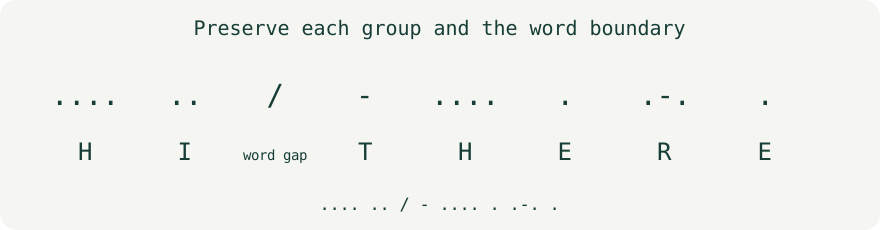
Find the marks and their grouping
Preview the image to inspect its symbols. A round bead or dot may represent a short mark and a longer bar may represent a dash, but the design’s convention needs to be established. Decorative elements, shadows or reflections should not be counted as signal marks unless the source indicates they are.
Look for gaps that separate letters before reading the entire sequence. If every bead is equally spaced, the intended character boundaries may be unclear. A possible-looking decoded word does not establish that the reading is correct; compare it with any known caption, original layout or sender’s explanation.
Transcribe one complete group at a time
Write periods for dots and hyphens for dashes. Add one space after each complete letter group and / after each word. For a visible H followed by I, type .... .. into the main decoder. Use the alphabet to check an unfamiliar group before continuing.
The preview is local to this page and does not run optical recognition. There is no automatic image-to-text result, confidence score or scanning engine. Once you enter the patterns, the text decoder maps those patterns into characters; it cannot inspect whether you transcribed the picture correctly.
Check orientation and uncertainty
A bracelet can be read from the wrong end, and an image can be mirrored. Identify the intended starting side before interpreting the pattern. If a mark is cropped or indistinct, return to the original image or ask for a clearer source rather than substitute a convenient dot or dash.
Decode a short known example first to confirm the convention. Then compare the final spelling and spaces with your notes. For a permanent design, preserve the original text alongside its grouped code so another person can verify the interpretation independently.
Work through the annotated example
The illustrated sample reads HI THERE. Four dots form H, two dots form I, and a slash denotes the word boundary. The remaining five groups spell THERE. The labels underneath the marks let you compare your transcription character by character before decoding.
If your source has no slash, use its visibly larger word gap only when the design supplies a spacing convention. A scratch or a decorative divider may not be a signal. Record an uncertain group as uncertain; do not guess a letter and then claim the whole image has been decoded.
Annotated transcription
| Position | Visible group | Character |
|---|---|---|
| 1 | .... | H |
| 2 | .. | I |
| Boundary | / | Word break |
| 3 | - | T |
| 4 | .... | H |
| 5 | . | E |
| 6 | .-. | R |
| 7 | . | E |
Uncertain source examples
| Appearance | Why it changes the answer | What to do |
|---|---|---|
| Reversed .- | Reading from the opposite end makes -. | Determine the intended starting edge; do not silently reverse an image |
| Cropped .... | A missing end dot can make ... | Keep the character uncertain until the full source is available |
| No visible letter gap | .. may be I or two E letters | Use the original layout convention; avoid guessing a boundary |
Worked examples
These patterns use International Morse. Spaces separate letters; / separates words. A slash in the original text is encoded as -..-.
- HI
- Try this message
.... ..0.78 seconds at 20 WPM - ANNA
- Try this message
.- -. -. .-1.74 seconds at 20 WPM